
AMITAEUS’ HOLISTIC HEALING MANUAL
A practical framework for understanding the forces that move, transform, and build the human system — and how their changing qualities can shape physical health, energy, mind, resilience, and the path back toward balance.
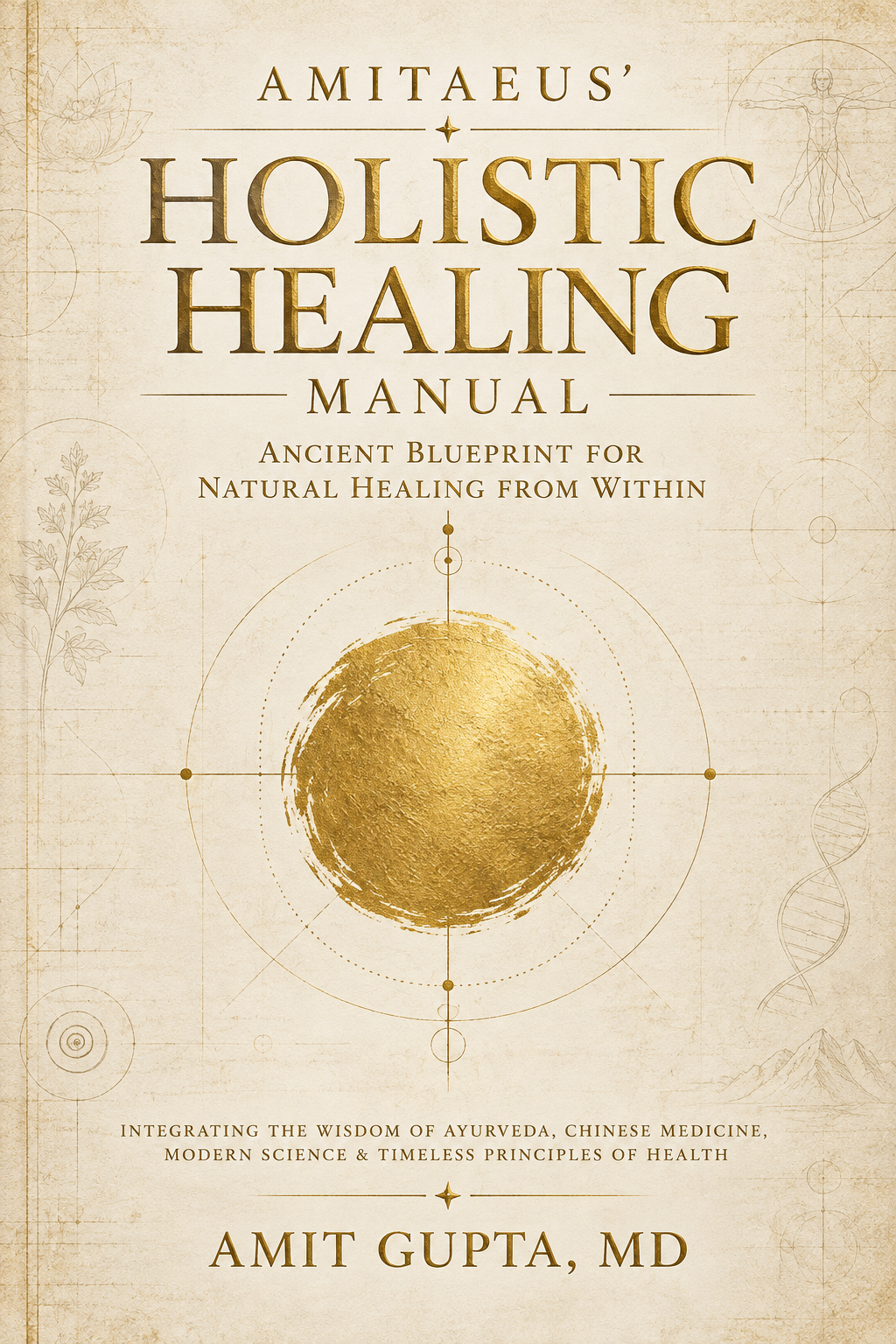
NOT ANOTHER LIST OF REMEDIES. A MAP FOR UNDERSTANDING WHY THEY FIT.
Most health books begin with what to do. This one begins with how to see.
The Manual develops a shared vocabulary for recognizing patterns across Ayurveda, Chinese medicine, Greek medicine, modern physiology, lifestyle, and the lived experience of the body. It does not claim that these traditions are identical. It asks what becomes visible when their observations are placed beside one another carefully.
The result is an integrated framework centered on three forces: Neuroactive, Thermoactive, and Trophoactive.
A map back to your center.
rather than memorized as abstract body types.
from the condition a person is in today.
and therefore call for different directions of correction.
food, sleep, movement, climate, stress, rhythm, environment, and attention.
Physical, Energy, Mind, Wisdom, and Harmony.
while the deeper conditions that created imbalance are corrected.
than repeatedly searching for a perfect static plan.
“BY WHAT MECHANISM?”
“Ayurveda has waited a long time for a book that neither dilutes itself for a Western audience nor asks that audience to convert. This is that book.”
Read the complete Foreword
I first met Dr. Amit Gupta at an Ayurveda training center in Kerala, India, many years ago. He was there learning a system that would have been easy to treat as a curiosity alongside his medical training. He did not treat it that way. We have stayed in touch ever since.
I have been teaching and practicing Ayurveda since 1988, in more than thirty countries, and in classrooms at UPenn, Jefferson, Hershey, and UMDNJ. The medical students and nurses in those rooms are not hostile to Ayurveda. They are curious, and they are trained to ask one question above all others: By what mechanism? Most people arrive at Ayurveda the same way, curious and wanting to know how it works.
My Ayurvedic medical education comprised more than nine years of full-time training at two prestigious, accredited universities in India, from 1982 to 1991. Since then, I have dedicated my career to the study, practice, and teaching of Ayurveda.
At my Ayurveda Wellness Center in Pennsylvania, I provide Ayurvedic care grounded in the core principles of the tradition, including residential Panchakarma detoxification therapies and approaches that support physical, mental, and emotional well-being. I also provide continuing education for Ayurvedic practitioners, integrative health professionals, licensed massage therapists, psychologists, and members of the general public.
Over the years, I have come to appreciate how often the word medicine is used too narrowly. Health and healing involve far more than medication, drugs, or surgery. Chronobiology, lifestyle, diet, nutrition, emotions, stress management, relationships, family, purpose, and even pleasure can all play meaningful roles in bringing a person toward greater balance and well-being.
For more than thirty years, my work has been to answer that question—By what mechanism?—without reducing an entire system of medicine to only those parts that translate easily into modern biomedical language.
The difficulty is structural rather than linguistic. Ayurveda organizes the body primarily by function. Modern medicine organizes it largely by anatomy, pathology, and measurable biomarkers. When I describe a patient in terms of Vata, Pitta, and Kapha, a physician may hear something poetic or untestable. When that physician describes the same patient through laboratory values and organ systems, I may see a person divided into parts that were never separate.
Both are describing what is in front of them. Neither is always fully equipped to hear the other.
What Dr. Gupta has accomplished in Amitaeus’ Holistic Healing Manual is to give the Ayurvedic tradition a vocabulary that answers that question for any reader, without asking Ayurveda to become something else.
Neuroactive, Thermoactive, and Trophoactive—translated here through the functional ideas of movement, transformation, and structure—are not replacements for the doshas. The Sanskrit terminology remains present throughout. These terms name the same three functional forces according to what they do, allowing a reader trained in physiology to follow the reasoning back to the principles articulated in the classical texts.
That may sound like a matter of terminology. It is the whole book.
I want to name what this book does because it is rarer than it should be. It claims its own ground.
The two systems are not necessarily competing because they are not always doing the same work. Modern medicine is built for the acute event, and it is very good at it. What it is not primarily designed to address is the long middle—the years in which conditions accumulate, patterns become established, and no single episode adequately explains what has happened.
That is where much chronic illness actually lives, and it is an area that episodic care cannot always fully reach.
This book takes up that ground and works it properly. It sells nothing.
There is no product, no proprietary formula, and no protocol waiting at the end of the book. Dr. Gupta’s position is that health is produced by the body under the right conditions, and that the work is to restore, support, and sustain those conditions.
This is consistent with the deeper classical position of Ayurveda, even though it is almost never the commercial one.
A book that teaches self-sufficiency ultimately makes itself less necessary. Few authors are willing to write such a book.
And this book does not overclaim.
Where the classical texts stand on their own authority, they are cited as such, without attempting to manufacture modern permission for them. Where contemporary research converges with Ayurvedic observations, that convergence is presented rather than used as a substitute for evidence. And where the evidence stops, the book says so.
That discipline is uncommon in this field—in both directions.
The manual follows the five koshas (layers), and this is not merely a matter of organization or decoration. It is why the book can carry a reader from digestion to awareness without breaking the continuity of its argument. Each layer rests upon the one beneath it.
A person whose physical and physiological forces are disturbed cannot simply be reasoned into wisdom, and this book does not try to do so. It begins by addressing the conditions of the body and gradually opens the deeper questions that depend upon a more settled mind.
Anyone who has attempted to teach meditation to a patient who is not sleeping will understand why the order matters.
Ayurveda has waited a long time for a book that neither dilutes itself for a Western audience nor asks that audience to convert. This is that book.
Its reach is wider than that of many works in this field. The everyday reader will find enough here to understand and apply important principles of Ayurveda to daily life. The practitioner, clinician, or physician will find enough substance to engage with the framework in professional practice and to consider how its functional language may contribute to a broader understanding of health.
I expect to be placing this book in the hands of both for many years to come.
WHAT READERS IN MEDICINE, HEALTH, AND AYURVEDA ARE SAYING
A book that teaches self-sufficiency ultimately makes itself less necessary. Few authors are willing to write such a book. What Dr. Gupta has accomplished in this manual is to give the Ayurvedic tradition a vocabulary that a reader can receive without any prior training, and without asking Ayurveda to become something else. It claims its own ground. There is no product, no proprietary formula. Ayurveda has waited a long time for a book that neither dilutes itself for a Western audience nor asks that audience to convert. This is that book.Vaidya Dr. Shekhar AnnambhotlaBAMS, MD-Ayurved (India), Founder, President & Chairman of the Board, Association of Ayurvedic Professionals of North America (AAPNA)
Amitaeus’ Holistic Healing Manual brings together ideas from ancient traditions and contemporary thought in an ambitious, wide-ranging guide. It invites readers to ask questions about the connections between daily habits, body, mind, and wellbeing. Readers open to reflective, holistic perspectives will find much here to consider.Dr. Adam C. Powell, PhDAdjunct Professor, Health Economics, Thomas Jefferson University
Two things stood out to me from this book. As a physician with a long career building pharmaceutical interventions and nutrition products, the target was always the same. Identify a deficiency, study a new product, show its efficacy, then make it part of a patient’s standard therapy. This book adds a variable I had not accounted for: the constitution of the person receiving it, which changes how a product performs and what outcome to expect. I also happen to be a professional chef. In the kitchen the working variables are sugar, salt, fat, acid, and heat, and they exist to build flavor. In medicine food arrives as calories and macronutrients. This book takes the same variables a cook already handles and reorganizes them around the qualities of foods. Acid and heat become warming or cooling. Fats are selected by constitution rather than by smoke point or flavor. Six tastes, each carrying a functional signal that tells the body how to process what it is given. None of it requires abandoning what a cook already knows, which is what makes it usable, and it is a model a chef can cook from. A must read for physicians and chefs alike, and for anyone who wants to learn to cook for their own body type.Dr. Eric First, MDFormer Medical Executive at Bayer, Ipsen, Sirtex, and Alcresta Therapeutics; professional chef
I have built population health programs for employers, insurers, and patients, including predictive models for patient dropout and non-compliance. The persistent gap was always the same. Uneven results were explained away as a compliance problem, and the solution was always to build more engagement. Reading this book made me think the problem sits upstream of that. The constitutional differences and force imbalances this book describes explain why a single program reaches some people and misses others, no matter how well it was designed. This is a valuable guide not only for a person managing their own diet and lifestyle, but for any clinician or medical director serving a population.Dr. Manish Oza, MDFormer Medical Executive at Anthem Blue Cross, Google, and Amazon; Emergency Medicine Physician
Same Food. Opposite Directions. Toward Balance.
Carole was 64 when she began changing the way she ate according to an Ayurvedic assessment of her constitution and current pattern.
The changes were not exotic. She shifted toward warm, moist, freshly cooked foods; used spices such as ginger, cumin, and cinnamon more intentionally; and established more consistent times for waking, eating, and sleeping.
Within weeks, Carole reported more energy and clearer thinking. Her joint pain improved dramatically. Over the following five months, she lost approximately 70 pounds—without intentionally restricting food and while eating meals she described as more substantial and satisfying than the diets she had followed in the past.
Naturally, she concluded that she had discovered a weight-loss diet.
Then her daughter began eating the same food.
Julie had struggled for years with severe underweight associated with an eating disorder. She began joining her mother for meals and gradually ate more of the same warm, cooked foods.
Carole became concerned. If this food was making her lose weight, what would it do to someone who desperately needed to gain it?
Same meals · different starting conditions · opposite direction of change
The opposite happened.
Julie gained approximately 40 pounds and stabilized, while Carole continued losing excess weight. Same kitchen. Same meals. Opposite changes.
Moved downward toward balance
- 64 years old
- Long history of weight struggle
- Began eating warm, cooked, constitution-oriented meals
- Reported greater energy, clearer thinking, and major joint-pain improvement
- Lost approximately 70 lb over five months
Moved upward toward balance
- 40 years old
- Long history of severe underweight and an eating disorder
- Began eating the same meals
- Began gaining weight and became more stable
- Gained approximately 40 lb and maintained it
“If food had a fixed effect, both would have moved in the same direction. They did not. They moved in opposite directions, toward balance.”
That is the distinction between a diet and a correction toward balance.
A diet is often presented as though a food has a fixed direction: eat this to lose weight, avoid that to gain weight.
Ayurveda asks a different question:
What is the present condition of the person receiving the food?
In the framework used in Amitaeus’ Holistic Healing Manual, both women displayed different expressions of a disturbed Neuroactive pattern. Regularity, warmth, digestibility, nourishment, and predictable meals represented a similar corrective direction—but each body responded according to what it lacked.
One moved down toward her baseline. The other moved up toward hers.
The goal was not weight loss or weight gain. The goal was balance.
Read the Full Case in the ManualThe full chapter explains how the three forces, digestive patterns, daily rhythm, and individual baseline fit together.
This is an individual case account and is not evidence that these dietary changes treat arthritis, obesity, anorexia nervosa, or other medical conditions. Eating disorders and significant medical symptoms require appropriate professional care.
THE MANUAL DOES NOT ORGANIZE HEALTH AROUND UNIVERSAL DIETS.
It asks what is out of balance in the individual, what qualities are driving that pattern, and what direction would restore the conditions the body needs.
A PRACTICAL STRUCTURE FOR AN 800-PAGE REFERENCE BOOK
Begin with the Three Forces
Neuroactive moves. Thermoactive transforms. Trophoactive builds. The foundational chapters establish the vocabulary of forces, qualities, patterns, and direction of correction.
Follow the Five Layers
Physical, Energy, Mind, Wisdom, and Harmony provide a connected path through the book rather than a collection of isolated recommendations.
Use it as a reference
Return to selected sections and graphics for sleep, digestion, food, mind, movement, environment, imbalance patterns, and bridge therapies. You do not need to read every page before the book becomes useful.
Keep a copy
close by.
For your bedside table, your next season of change, or the person you love who is ready to understand their health differently. Choose the edition that feels right for you.