
THREE FORCES. FIVE LAYERS. ONE LIVING SYSTEM.
Across ancient medical traditions, health was understood through recurring patterns of movement, transformation, structure, and balance. Amitaeus translates those patterns into a clear modern framework for understanding why different people respond differently — and why health must be personal.
BEFORE THERE WERE SPECIALTIES, THERE WERE PATTERNS.
Ayurveda, Chinese medicine, Greek medicine, and other traditional systems developed different languages for observing the body. They are not interchangeable, and this work does not force them into one system. But across them appears a recurring insight: people differ in how they move, transform, build, adapt, deplete, accumulate, and recover.
Modern medicine has become extraordinarily precise at identifying disease. The older systems asked an additional question: what kind of person is experiencing it, and what pattern brought that person there?
Amitaeus begins with that question.
A MODERN LANGUAGE FOR AN ANCIENT IDEA
The books use three functional terms to make the traditional patterns easier to understand without requiring prior knowledge of Sanskrit or classical medicine.
Neuroactive
Movement · signaling · transport · variability
The force that moves information, impulses, breath, circulation, elimination, attention, and change.
Thermoactive
Transformation · heat · metabolism · conversion
The force that transforms: food into usable material, perception into understanding, and activity into output.
Trophoactive
Structure · stability · nourishment · reserve
The force that builds, lubricates, stores, protects, stabilizes, and gives the body substance.
These forces are not diagnoses and not personality labels. They are a way of recognizing recurring functional patterns — and of understanding what happens when a useful quality becomes excessive, insufficient, or poorly coordinated.
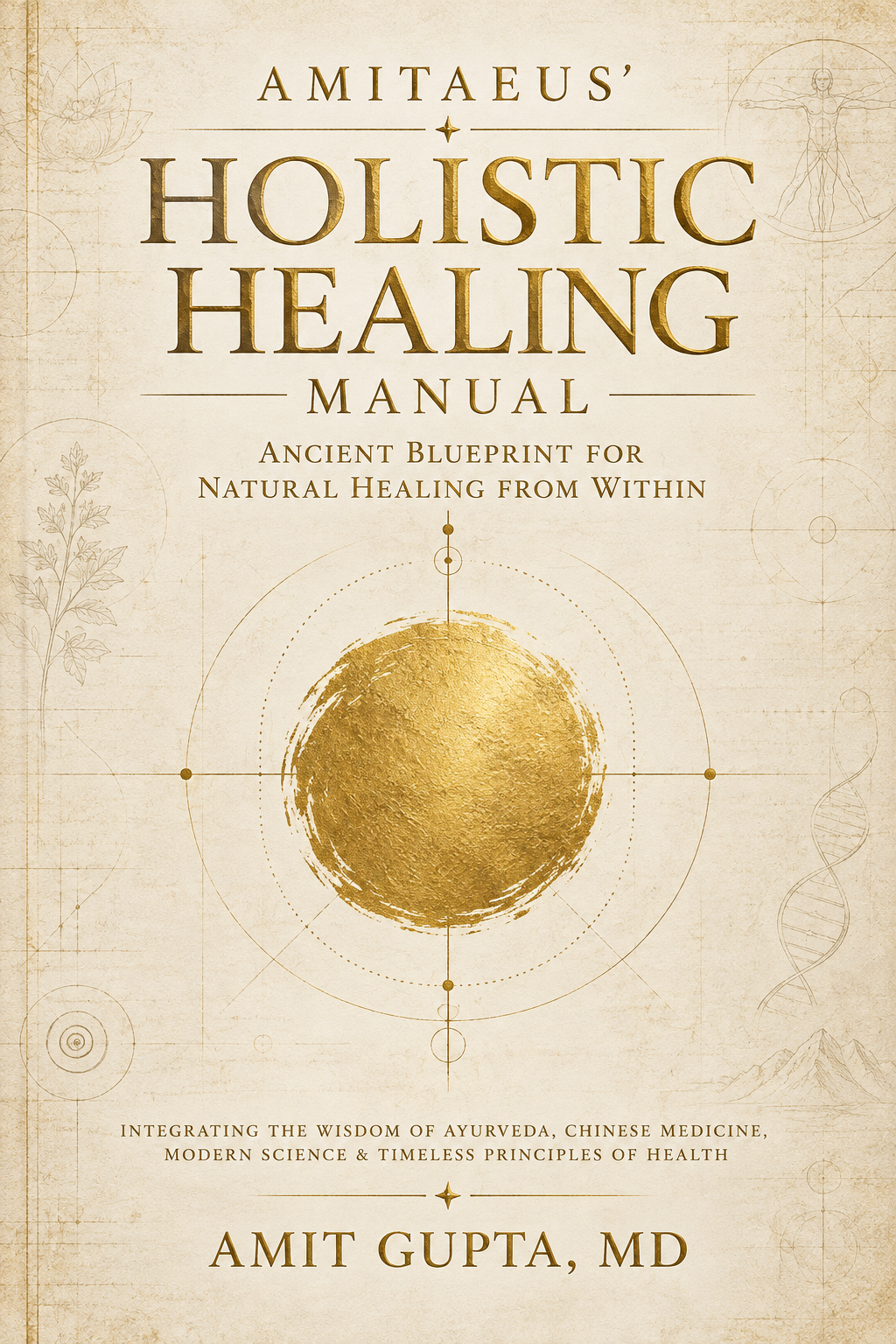
Learn the Three ForcesAMITAEUS’ HOLISTIC
HEALING MANUAL
An approximately 800-page reference manual that builds the foundation first, then shows how the same principles can be followed through the physical body, energy, mind, wisdom, and the conditions that support harmony.
This is not a book that asks to be memorized from beginning to end. Read the foundation. Learn the map. Then return to the Manual when a pattern, symptom, therapy, or question needs context.
A book that teaches self-sufficiency ultimately makes itself less necessary. Few authors are willing to write such a book. What Dr. Gupta has accomplished in this manual is to give the Ayurvedic tradition a vocabulary that a reader can receive without any prior training, and without asking Ayurveda to become something else. It claims its own ground. There is no product, no proprietary formula. Ayurveda has waited a long time for a book that neither dilutes itself for a Western audience nor asks that audience to convert. This is that book.Vaidya Dr. Shekhar AnnambhotlaBAMS, MD-Ayurved (India), Founder, President & Chairman of the Board, Association of Ayurvedic Professionals of North America (AAPNA)
HEALTH DOES NOT EXIST IN ONE LAYER.
A symptom may appear in the body, but the conditions shaping it may involve energy, attention, behavior, environment, meaning, or the way the whole system coordinates. The Manual follows health through five connected layers:
structure, material, digestion, metabolism, elimination, and the body itself
capacity, rhythm, movement, recovery, and usable vitality
regulation, perception, emotion, attention, and response
discernment, pattern recognition, choice, and self-correction
the degree to which the layers work together rather than against one another
The goal is not perfection in every layer. It is coordination.
whole
person
THE SAME INPUT DOES NOT PRODUCE THE SAME RESULT IN EVERY PERSON.
The same diet can steady one person and deplete another. The same schedule can sharpen one and exhaust another. The same diagnosis can arise through different paths. A standardized recommendation can therefore be correct in general and still be wrong for the individual in front of you.
The three-force framework provides a practical language for those differences — not to replace diagnosis, but to understand the person who carries it.
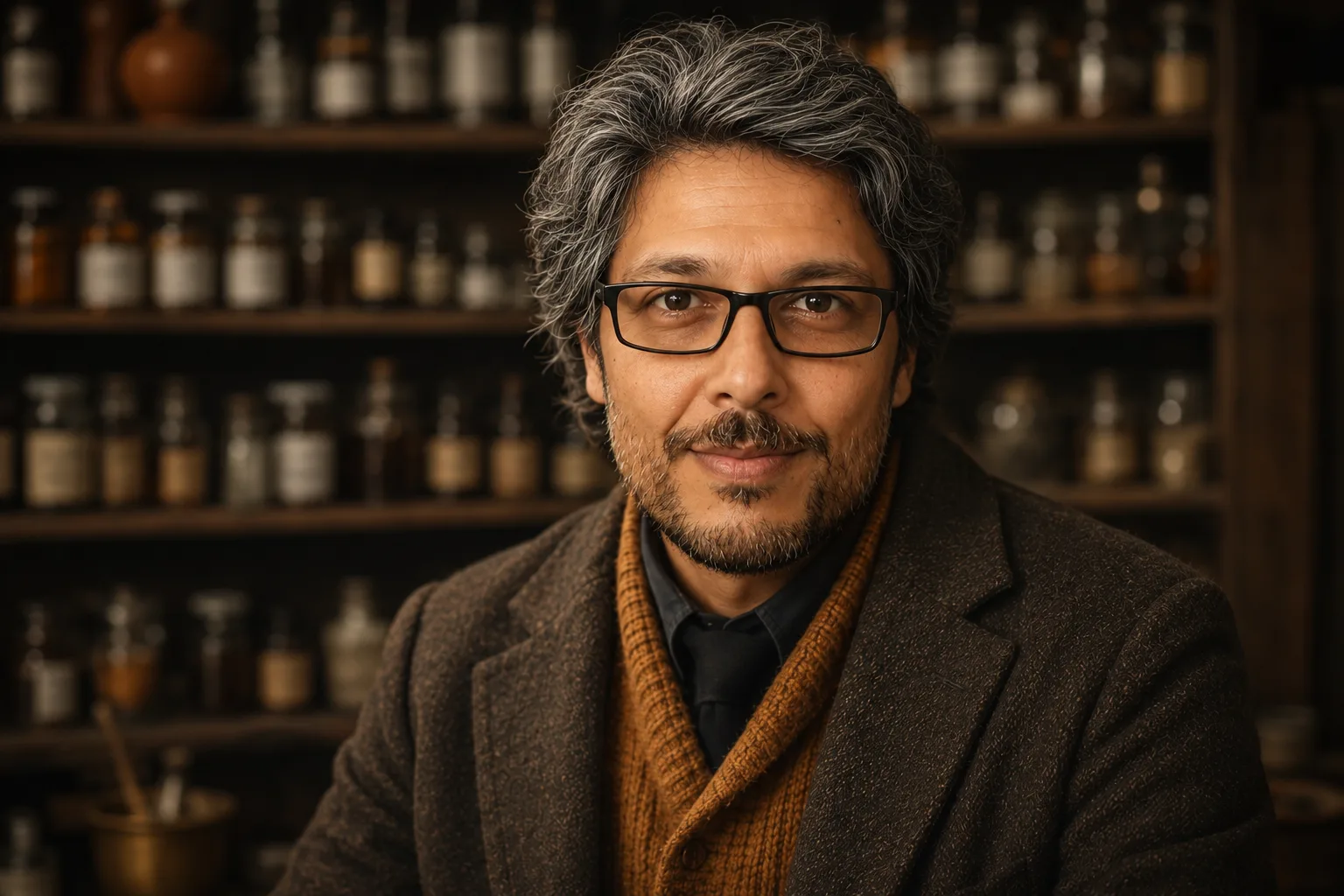
A PHYSICIAN’S QUESTION, FOLLOWED FAR ENOUGH
MD · Ayurvedic Practitioner · Researcher · Healthcare Innovator — View CVCONTINUE THE JOURNEY
Interested specifically in Ayurvedic pulse assessment? Explore Nadi Pariksha, its history, and the research at AyurvedaPulse.com.